Google+
Showing posts with label Tactic. Show all posts

Thursday, December 1, 2011

Doctrine vs Strategy

Doctrine, Strategy and Tactics all differ slightly.  Strategy defines the objectives needed to achieve success.  Tactics describes how those objectives will be taken.  But dictating over both is Doctrine.  Doctrine is a military concept, but also one which can be applied to players when playing a game.
Doctrine
Doctrine is something which is taught, and it becomes and these teachings become an ingrained belief.  Often armchair generals talk about "why didn't xxxx use yyyy when it was obvious zzzz wasn't going to work?"  The reason: Doctrine.

Doctrine forms the basis of military thinking around how the next war will be fought.  As such, it determines what military engagements "should be like" in the next war.  Nations then build units around this "should be" doctrine.  This enters into a self-fulfilling prophesy, however.  As the units are designed for a specific type of war, then the next war is fought using the tactics which best fight that type of war.  Thus, in most cases, Doctrine is "correct" not because it is "valid", but because the units are designed to operate in that way under the best conditions.

Changing Doctrine
Doctrine can change, albeit usually under duress.   It would be great to say Doctrine changes before it is required, but often this is not the case.  Doctrine changes primarily when:

  • Technology makes it obsolete,
  • Terrain makes it impossible, 
  • Necessity demands it.

In the American Civil War (ACW) tactics were driven by the Doctrine taught at West Point, which were a product of Napoleonic wars.  In true Napoleonic style, this meant the three arms of the army (Infantry, cavalry, and Artillery) working together in coordinated unison.  However, in the United States the terrain prevented much of that required coordination.  Technology changed such that artillery was deadly at long range, disrupting the ability to hold formations together.  During the ACW, the defensive was so much stronger than offensive, the South eventually developed "Trench Warfare".  This confirmed what the British learned during the New Zealand Wars (aka: Maori Wars), fighting behind fortifications in long lines would cause greater damage to an attacker than the defender.  Unfortunately, this lesson was essentially ignored by the military of all nations until World War I established trench warfare as the new doctrine until the development of aircraft as the decisive weapon of war.

Necessity also demands changes.  Nearly all navies of the world subscribed to the "Decisive Battle Doctrine", where a great naval battle of both sides duke it out and the war is then decided.  At the center of this naval doctrine was the battleship.  With the destruction of the American battleships in the Pacific in 1941, the US was forced to change its doctrine.  The US fleet could not take on the Japanese fleet in a decisive battle.  Instead, the US adopted a "Commerce Raiding" doctrine.  American fleets avoided large scale battles with the enemy where possible, instead focusing on destroying critical enemy ships at given times, and then retreating to conserve ships.  Only after achieving production superiority did US ships engage in fleet battles, and even those were initiated by the Japanese.

Doctrine In Games
A major difficulty for designers becomes the recreation of "period" doctrines.  In many ways it is simpler to simulate units at the operational level, where the distinction between types of units becomes blurred and all that matters are armies.  At lower levels, it becomes more difficult as the differences between the types of units: artillery, infantry and cavalry, become more distinct.  Unfortunately, it is tempting to use 'Napoleonic cavarly' with a "german Blitzkrieg", a way in which cavalry were not used.  Some systems attempt to prevent this in the rules, but this can quickly create a large rules set with many exceptions.  
Doctrine Of a Player
Players also adopt a play style which can become their "Doctrine".  I know of a player who prefers the idea of "bigger is better".  Regardless of the game, the player will always build the unit with the biggest guns, despite the evidence there are more cost effective units out there.  The result is the player becomes predictable and easier to counter.
Know Your Doctrine
Knowing your style of play becomes critical to understanding your strategic and tactical blind spots.  Oftentimes I will try a new strategy not out of boredom, but to see what I can learn about my play style.  This challenges me to try to work outside what I'm familiar with and learn how others counter it.  I like to think it makes me a better player in the long run, it certainly doesn't add to my Win-Loss rate in the short term, but it keeps my opponent's from knowing what I will do next.  And, every once in a while, I combine elements to form a new strategy which throws everyone off kilter, and makes the game fun.

Sources:
Carl Boyd, "The Japanese Submarine Force and the Legacy of Strategic and Operational Doctrine Developed Between the World Wars", in Larry Addington ed.Selected Papers from the Citadel Conference on War and Diplomacy: 1978(Charleston, 1979) 27–40; Clark G. Reynolds, Command of the Sea: The History and Strategy of Maritime Empires (1974) 512.


The Joint Army-Navy Assessment Committee (February 1947), Transcribed and formatted for HTML by Larry Jewell & Patrick Clancey, ed., HyperWar: Japanese Naval and Merchant Shipping Losses During World War II Japanese Naval and Merchant Shipping Losses During World War II by All Causes NAVEXOS P-468Hyperwar project ed. Patrick Clancey


"Japanese Naval and Merchant Vessels Sunk During World War II By All U.S. Submarines". Valoratsea.com. Retrieved 2010-10-31.


 "Creating military power: the sources of military effectiveness". Risa Brooks, Elizabeth A. Stanley (2007). Stanford University Press. p.41. ISBN 0804753997


Joseph H. Alexander, Closing In: Marines in the Seizure of Iwo Jima (1994) a short Marine Corps history


Schenker, Carl R., Jr. "Ulysses in His Tent: Halleck, Grant, Sherman, and 'The Turning Point of the War'". Civil War History (June 2010), vol. 56, no. 2, p. 175.


Simpson, Brooks D. "After Shiloh: Grant, Sherman, and Survival". The Shiloh Campaign. Carbondale: Southern Illinois University Press, 2009.


Steere, Edward. The Wilderness Campaign. Harrisburg, Pa.: Stackpole Co., 1960.


Saturday, November 19, 2011

Surface Area III...Defensive Options

First, I have added a poll question to the right bar which I'd like to collect everyone's response.  Please let me know what you think.
The Player's Positions
Yellow: On the Defensive
It may seem Yellow has no actions when on the defensive, but there are things Yellow can do to adjust the mental state of their opponents.  This allows Yellow to control their opponent's actions to a degree.  However, first Yellow must come to terms with a given fact:
Yellow Will Lose Territory.


Inevitable Loss of Territory
Unless Yellow has an unusually large number of units compared to their opponents, it is not possible for Yellow to defend every space.  The following chart lists each color, their number of units, and their 'Army Density': how many troops may be spread evenly along each location adjacent to an enemy.

Player Spaces Surface Area Army Density
Blue 15 5 3
Green 12 7 1 (5 Leftover)
Red 9 4 2 (1 Leftover)
Yellow 14 10 1 (4 Leftover)

Wednesday, November 2, 2011

Surface Area II...Plan of Attack

When dealing with Irregularly Shaped boards, it is necessary to consider the areas to attack and how to defend against them.
A Game "In Progress"
Here we have basic Risk style game in progress, using the map of the US as the board.  The states occupied by a player all show the same color.


   Blue = 15 Armies
 Green = 12 Armies
Yellow = 14 Armies
   Red = 9 Armies


For this example we will have the following rules:
  • Every state provides one army per turn, which may be placed in any state(s) the player controls,
  • Every state may only attack states adjacent to them,
  • A player may not 'Blitz' -- launch an attack from a recently captured territory (Example: I capture Colorado this turn, I may not then attack from Colorado this turn, but may do so next turn).
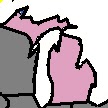
Michigan in Pink
It's all one state
We will look at various sides to determine the best possible moves and how the irregular board affects their decision making.


NOTE: Michigan is oddly shaped and in the main image appears as if it is two separate locations.  However, it is important to realize this location is all one state.
Yellow: On the Offensive

Yellow appears to be in the worst possible position militarily.  Yellow has charged up the center and now occupies 14 regions.  Normally in a game where a player creates a bulge like this it is not a good thing.  Despite receiving 14 armies, Yellow can be attacked into 10 different locations.  Trying to defend all of these locations is nigh impossible, especially considering they may face the might of all three opposing powers.


Yellow needs to consolidate it's power.  The answer is to attack.  The question is "Where?"
Positive Attacks
Positive Attacks
Since the concept is to reduce Yellow's surface area, Yellow should consider attacks into the locations indicated on the right.  The two attacks against Red in the upper left should be made first as they will decrease Yellow's overall surface area from 10 to 9.


When on the offensive, any Reduction in Surface area is a good thing.  Therefore, these attacks are a Positive Attack: an attack the player should definitely make!  The order of the attacks is important.  The northernmost attack should be made first as, by itself, it is a Neutral attack. 


Negative Attacks
Increase Surface Area
Negative Attacks
Attacking any of the states shown in the diagram below will result in Yellow increasing the surface area.  This will result in Yellow spreading its troops even thinner in order to hold on to the state.  Even if Yellow were to win ever battle there would be a net increase in surface area.  Unless a player has overwhelming superiority in force, or there are no other options remaining, negative attacks should be avoided.


Neutral Attack
Neutral Attacks
The attack into Missouri will result in a neither an increase nor a decrease in surface area.  As such, the player may decide to make the attack or choose to wait it out.  Such territories are considered 'Neutral Attacks', as they provide no tangible benefit, but carry no additional risk.


Some games, such as Risk, give a player a bonus if capture a territory.  In the case of Risk, if a player captures one territory during their turn they receive a card.  When matched with other cards the player has collected, the player may trade them in for additional armies.  For many such games, these additional armies become critical to winning the game.  This can shift a Neutral Attack to a Positive Attack.  However, if the player has already captured a territory somewhere else, the benefit (the card) has already been earned.  This once again relegates the attack to being 'Neutral'.


Neutral Attacks should be undertaken only if the player has sufficient force.  It can also be used as a bargaining chip for negotiations with other players.


Conditional Attacks
Conditional Attacks
The two attacks on Red's southern states (Arizona and Utah) normally would yield negative results.  Even if both states were won together they would result in a net increase in surface area.  However, if the two attacks above it are successful (see Positive Attacks above), then winning both states would result in no overall net increase in surface area, but the player would control more states resulting in more armies.


This makes these attacks 'Conditional Attacks'.  Making these attacks is dependent on the outcome of some other attack(s).  They are also dependent upon having sufficient forces available for both attacks to be successful.


Next Article
The next article will discuss what Yellow should do if it is not its turn and is forced to act defensively.

Saturday, October 22, 2011

Surface Area

Map of Red Storm Rising -
Thin black lines indicates the various spaces
In past articles we discussed hex based war games.  Not all war games are hex based, some have irregularly shaped spaces which create an interesting mosaic for players to work around.  Although many of the same advice can apply to these types of games, there is one concept particular to these games to discuss: Surface Area.

Irregular Board
The following board comes from Red Storm Rising(RSR).  The spaces are all polygons, mostly four sided, but put together like a mosaic.  This type of board can require some time to decipher.   Unlike hexagonal grids, where distance become easy to determine by simply counting from one hex to another, irregularly shaped boards do not always have a "clear shortest path" from one location to another.  Adding in terrain effects (Rivers in RSR are more difficult to cross), and the calculations become more challenging.

The first question which comes to mind is "Who would come up with such a crazy map scheme".  Probably the same group which tried to break states up by natural border lines, waterways, and political boundaries.  An example of such a map is provided below:
Look familiar?
Surface Area
The "Surface Area' of any given location is equal to the number of adjacent spaces.  Color coding our Map of the United States, we get the following:
Individual Surface Areas of the States

Maine, the state in the uppermost right, is the only state adjacent to a single other state.  This means any attacks must come from New Hampshire.  Compare this to Texas, the large state in the south, which may be attacked by any of its four neighbors: Lousiana, Arkansas, Oklahoma, and New Mexico.  As expected, the states at the edge of the map have fewer neighbors than in the middle.  Still, one state, Kansas, is dead center in the map but only has four neighbors.

Objective of Surface Area Games
Normally, in games with irregular maps, players try to create 'fronts'.  A front consists of a group of units strung out along a contiguous line which faces the enemy.  Since most games limit the number of units a player receives each turn, it is best if the player's front is smaller than their opponents.

This becomes basic mathematics and a war of attrition.  If players received 12 units a turn, the player who occupies 4 locations will have 3 units added to each territory.  If their opponent occupies 6 locations, then the opponent will have only 2 units per territory.  Furthermore, the player has the option of attacking any 6 of their opponent's locations.

Kansas: Breadbasket, Corn fields, Stronghold
Missouri: watch your back, front, top, bottom...
Stronghold of Kansas
Some games permit units from surrounding territories to combine their units in attacks.  Even with this rule, Kansas stands out as a 'stronghold' in the center of the map. At most, 4 states could attack Kansas.

Compared to the state to its left, Missouri, where 8 states could combine efforts.  In this case, the smaller surface area again provides advantages in defense.

Oddities like the "Stronghold of Kansas" exist in many such games.  Identifying these oddball locations can create situations where players' "run to Kansas" just to force their opponents to thin their lines.  In the Kansas situation, it is odd because it rests in the middle of the board.  Thus, it differs from "Fortress Australia" from Risk.


Siam: Gateway to Fortress Australia

Fortress Australia

"Fortress Australia" is another common configuration found in games with irregular boards.  Made famous by Risk, the Fortress Australia configuration is more easily identifiable than "Stronghold Kansas".  The primary feature is a section of the map with an obvious choke point.

In the game of Risk, the continent of Australia can only be attacked through Siam.  Furthermore, if a player controls all of Australia's territories, the player gains bonus armies.  While the bonus armies are few compared to North America, Europe, Africa or Asia, Australia has an advantage in that it is easy to defend.  Furthermore, Australia is isolated next to the largest bonus continent: Asia.  Defending Australia consists of Occupying Siam and building a massive force.  While holding Siam, Australia provides 2 bonus armies and denies a player Asia's benefit of 7 armies.

The "Fortress Australia" is usually fairly obvious and the strategy around it is fairly simple.  Railroad Tycoon has a similar "Fortress Australia" in the Northeastern States, where there is a greater concentration of cities with relatively easy terrain.  If left alone, a single player can quickly dominate the game.

Next Article
The next article will discuss more about Surface Area as it applies to the players positioning.  We will cover Tips for Attacking and Defending, setup the ground rules for a sample game, and discuss how irregularly shaped boards need to affect the overall strategy.

Sunday, October 16, 2011

Hex War Games - Right Unit for the Job

Generally speaking, when attacking or defending, the smartest action involves using the best unit type against the enemy unit.  These are not always clear cut, but the following recommendations make good generalization.

vs. Infantry
Unlike most of the other units, the power of infantry lies on the terrain it occupies.  If in the enemy is in the open, hit infantry with armor, artillery or air units.  In any other terrain, it requires a combination of units to bring infantry down.  This is due to the fact nearly every other terrain allows infantry to sneak behind and get close to the attacking unit, except in Open terrain where there is no cover.  In jungle terrain, infantry are the best unit to use against other infantry units, although mobility becomes difficult.

vs. Armor
When combating armor in open terrain, use artillery, anti-tank guns, and other armor to bring them down.    In the case of anti-tank guns, attempt to provide them concealment to ambush the tanks.  If given notice of where the AT guns are located, armor can either engage the enemy AT guns from a distance or stay out of reach and bypass them.  Even Self-Propelled AT Guns are only good in ambush as they must rotate the entire vehicle to engage the tank.

If armor is in a city or any other terrain type, infantry are by far the best unit.  When in enclosed terrain, such as cities or forests, tanks suffer from many blind spots.  Additionally, infantry can rise up from beneath the belly of the tank (think sewers or mines), or they can fire down from the tops of tall buildings. 

vs. Artillery
Best use against artillery is to get in close and hit it with anything.  Even during the Civil War, when artillery was armed with canister rounds which would shred infantry to pieces, the long reload time of artillery meant if the infantry held together they could usually take the pieces, if the artillery was unsupported.

Otherwise, the best unit to hit Artillery is probably air units or other artillery units.  If there is insufficient Air Defense units, artillery are a sitting duck for aircraft.  Artillery should be at the top of the list of units to destroy.  Without artillery, attacks will eventually falter and defenses will eventually fall.

Artillery does have one very weak spot that, if the game allows for it, should be exploited: the baggage train.  Armor can carry jerrycans of fuel and attacks generally have enough fuel to attack in and, if it falters, flee back.  Infantry can carry days or weeks worth of supplies, plus small infantry units can always "live off the land" if there is sufficient livestock nearby.  And in close in fighting a person with a pitchfork can be as deadly as a man with a pistol.

Artillery, however, must have a constant supply of ammunition to be effective.  Furthermore, the munitions themselves are explosives.  Destroying this "baggage train" of explosives, or even disrupting the supply line for a turn or two, can remove artillery's effectiveness and leaves the artillery canon unscathed for capture.

vs. Air Units
The effectiveness of Air Units will differ depending on the era.  WWI aircraft were effective at spotting for Artillery, tracking enemy movements and possibly attacking ammunition depots.  The ability to track enemy movements was, by itself, enough of a threat to make taking down aircraft an important goal.  One important development in WWI aircraft was the creation of specialized "roles": Fighters, Bombers, Spotters, and Recon.

By WWII aircraft came into their own.  American aircraft were the primary means by which they defeated the Imperial Japanese Navy (IJN).  Strategic Bombing changed the face of warfare, bringing the concept of "total war" to fruition, making every person a subject to the pains of war.

There are two primary defenses against Aircraft: Air Defense Guns (AD, includes Surface to Air Missiles for purposes of this discussion) and other fighter aircraft.  Of the two, fighter aircraft are the most effective at shooting down other fighters in interception-based engagements.  However, AD can be extremely effective in defense of a given point.

This sounds confusing, but basically AD guns are static and can only defend a given area around the gun.  Aircraft have the ability of engaging the incoming enemy at any point in the enemy flight path, as long as the enemy can be identified.  Thus, if defending a given point or unit, such as a supply depot, large numbers of AA units surrounding the area will provide adequate defense.  If the need is to attack high flying bombers out of the range of AD units, other aircraft become a necessity.


vs. Ships
The best units against ships is a submarine.  But against a fleet of ships, I recommend aircraft.  Left to their own devices, the best way to attack a ship is to put a submarine just off the path of the ship.  The submarine simply waits, and then ambushes the ship, remaining silent and hidden the entire time.  The trick becomes predicting what the enemy ship's path will be, as the enemy will zig-zag the course.  Although capable of moving underwater, submarines are to slow to catch even the smallest of ships without surfacing, thereby losing their advantage.

The second best method is with Aircraft, if they are available.  Aircraft can fly high above the target, and attack ships with either bombs or torpedoes.  If in a fleet, aircraft will have to attack en masse, relying on numbers to sink or damage the target.  Once spotted, a single aircraft will have difficulty escaping a fleet of specially armed AA destroyers, and if a carrier is nearby, one can expect a swarm of fighters to flood the area.

If playing prior to the introduction of aircraft or submarines, the best way to engage a ship is with a larger ship.  In the age of sail, positioning or "crossing the T" may make up the difference.  In this case, it is not the larger ship which makes the difference, but the number of canons which can be brought to bear on the enemy ship/fleet at one time.  This is much harder to calculate, and where one must use judgement.

vs. Submarines
Post-WWII, the best anti-submarine weapons is another submarine, preferably an attack submarine.  In a pinch: aircraft, destroyers, and even some cruisers have anti-submarine weaponry.  During diesel age of submarines, the best weapon was the aircraft.  A submarine was force to charge its batteries and much of its "strategic" movement was performed on the surface.  Aircraft were best at ambushing these machines while they were on the surface.  In all those cases, however, their effectiveness depends on number of units, quality of units, and luck.

Oddly, submarines are the best way to sink an enemy submarine, but a fleet of anti-submarine ships is the best way to suppress a submarines.  Place enough anti-submarine ships between the submarine and its desired target, and the submarine may give up.    Once detected, submarines must go defensive, their ability to attack diminishes greatly.    While a single ship attempts to engage the submarine, the fleet slips away.  Aircraft cannot maintain the constant contact and attack runs against submarines like specialized Anti-sub destroyers.

It is necessary to therefore determine the objective when dealing with submarines: is it to sink the submarine, or to protect the fleet.  If the former, it may require multiple ships, at the expense of leaving the fleet insufficiently guarded, and the submarine may still escape.  In the latter, it may take one or two fast destroyers and the fleet or convoy is perfectly safe.  Destroying a submarine may "feel good" to a player, but if it prevents the fleet from arriving on time to save the land troops, consider the victory a defeat.

vs. Cavalry
Cavalry represent a special case.  Cavalry combine elements of submarines and armor.  The best counter against cavalry in a straight up fight is infantry.  A solid infantry square of poorly led troops still  has good odds of defeating a cavalry charge.  This is because cavalry, once removed from their horses, are weak infantry.  Like armor, cavalry units need to engage units in the open, as the forest terrain breaks up the formation too much, while swamps, jungles and mountains will damage the mounts.  Unlike Armor, cavalry can rarely perform true 'breakthrough' attacks independently and wait for infantry reinforcements. Cavalry historically are used to either pin the enemy down until reinforcements arrive, harass the enemy baggage train, or finish off retreating units after they have already been routed.

However, Cavalry can provide fast support where needed.  This requires another quick unit to intercept and engage them before they can provide that support.  In this case, the best unit is another cavalry unit.  However, Cavalry on Cavalry exchanges will result in heavy losses from either other, and it is not always easy to determine which side will suffer.  Often times, simply engaging the cavalry to slow them down is enough to counteract their effects.  Thus, Cavalry can be a 'situation' unit, one which may be incredibly useful if in play, or completely ineffective.

Saturday, May 28, 2011

Military Terms Part I

This entry is inspired by a good friend of mine after he left a comment on one of the facebook entries: "Hull down!  Defilade! Enfilade! Flank!  Grazing fire?  Why don't we just shoot right at them?"  Well, Brian, this ones for you!  And a warning, although this is inspired by his entry, he knows his stuff and is a heck of an opponent (who I don't get to play often enough.  When you going to make it to Co, Buddy?).


There are many words or phrases used to describe the types of fire available.  There are many terms used to describe various common military positions.  Knowing these terms allows a quick description of a complex situation.


Enfilade
Enfilade is the French word meaning "to skewer".  In military parlance, enfilade is when a unit receives fire along its longest axis.  Another way to visualize it is to imagine a line of troops standing shoulder to shoulder and the firer is firing along the line of solders so one bullet could travel in a straight line and hit multiple soldiers.
Blue is in Enfilade from the Green Tank


So, Enfilade Fire is simply 'Flanking Fire'?  No, flanking fire means attacking just from the side of a unit.  In Napoleonic times, soldiers would marching in long columns.  If, while marching in column, they suddenly came under fire from the front the unit is in enfilade, but they are not flanked.

Proper grammatical use of Enfilade is almost backwards thinking for English speakers, but critical to understand.  Enfilade is used to describe the position the enemy is in, not the firing unit.  Adding to the confusion of the use of the word is a position is only in enfilade when it is fired on, thus, some unit must be providing the 'enfilading fire'. Thus, in the diagram above, the blue troops are in enfilade by the green tank which is providing enfilading fire.

Defilade
Defilade is another French term meaning "to scroll".  A unit is 'in defilade' if it uses natural terrain to shield or conceal its location.  

In modern terms, defilade is also used to describe a position where a unit uses a natural depression, or the reverse slope of a hill, to reduce its exposure.  For tanks, this is the same as 'hull down' or 'turret down'.  Unlike enfilade, a unit does not have to be under fire to be 'in defilade'.  Units may move along the backside of a ridge to remain in defilade.

Three tank positions: Upper is "Exposed".
Middle is "Hull down" and the tank's main body is 'in defilade'.
Lowest position has the entire tank 'in defilade'.
Suppressive Fire
Suppressive fire is the concept of reducing the enemy units ability to return fire by shooting in their general direction.  NATO has a more definite term, including creating distractions, which reduce the enemies ability to complete its fire objectives.  Simply put, this means creating enough distractions to keep the enemy busy.  Typically, a unit only remains suppressed for as long as the suppressive fire is maintained.

British forces used the term 'neutralized' with the same meaning as 'suppressed'. NATO defines neutralized as the unit being reduced to ineffectiveness over a longer time period. 

Suppressive fire is a critical piece of modern military doctrine.  For me, suppressive fire differs from 'pinning fire', in that it limits the ability of the unit to return fire, but the unit may retain the ability to move.

Pinning Fire
Pinning fire is bringing enough firepower to an area to limit the units ability to move from its current position.  Usually, a pinned unit is also suppressed, unable to return fire.  Pinning units is critical for holding the unit in place while other units move into position to finish the unit off.  A unit unable to move because of enemy fire is said to be 'pinned'.

Overwatch
Overwatch is related to the above to items.  Basically, it describes when some unit supports another unit by being available to provide suppressive fire or pinning fire while the supported unit moves into position.  This is similar to the artillery "leapfrog" tactic, except that artillery provides supporting fire to other units, not to each other. 

Bounding Overwatch 
Bounding overwatch is the official name for 'leapfrogging'.  Part of the unit stops and fires while the rest of the unit moves.  Bounding Overwatch is used mostly in infantry and close terrain (forests, cities, etc.) in modern warfare.  In WWII, tanks often used bounding overwatch since the ability to fire on the move was unlikely to produce any results.  Prior to WWII, the concept was known, but not practical to implement since communications and coordination of units was difficult prior to the introduction of radio.

Saturday, May 14, 2011

Hex War Games - Strategy Part XV - Protecting Artillery

Alluded to in the earlier article was the necessity of protecting artillery, particularly through 'pairing'.  I received some emails asking for examples of what I mean, so this article will explore the concept further.

For this article we will make the following assumptions:
  • It is desirable to protect Artillery from attacks on the front and frontal-flank positions.
  • Artillery has a minimum range of 3 hexes and maximum of 4 hexes
Unpaired Artillery
In the diagram below, the artillery is unpaired. each artillery unit has its own guard of 3 tanks each to prevent the enemy from attacking the artillery units.

Unpaired Artillery
An advantage for this configuration is each artillery unit and its guarding units are autonomous.  They may move around the board as needed.  The major drawback is the number of units required to protect the artillery.  In limited unit games, it is nice to have as many units assaulting as possible.  This configuration requires 6 units be used to protect the 2 artillery.

Loosely Paired
Moving the artillery units just two spaces closer together, the artillery becomes 'paired'.  Paired artillery share the same guarding units.  In this case, the center tank is a shared defensive unit.

Loosely Paired Artillery
Although it seems like the center unit would be a weak point, for if it were to fall than both units are exposed.  However, it is actually a strong point.  Both artillery units can call down fire onto that hex directly in front of it, subjecting the enemy to a withering fire.  Lastly, this defense requires only 5 units rather than the initial 6, freeing up an additional unit.

Tightly Paired 
Moving the artillery units closer by a single hex reduces the number of guard units by one yet again.  The artillery units are now tightly paired, but now the number of guarding units is 4, freeing up yet another unit for other duties.  If the enemy were to assault the two frontal units, both artillery could be used to protect either unit.
Tightly Paired
Compact Paired 
A final configuration for protecting artillery units exists, the compact paired.  in this case, the artillery units use only three guardians.  The artillery units must be in adjacent hexes for this configuration to work, as shown in the diagram below.

Compact Paired
Although the guarding units are shown in a non-symmetrical configuration, they can be arranged with overlapping ZOCs if desired.  However, the shown configuration above does allow for 'leapfrogging' artillery (by one space) and still maintaining the defensive arrangement.  To perform the maneuver, the center tank would "shift" one hex to the upper right while the rearmost artillery and its flank covering tank move up one hex.
Compact Paired Artillery - Leapfrog Moving 

Saturday, May 7, 2011

Hex War Games - Strategy Part XIV - Artillery Use

Artillery suffers from unique weaknesses and strengths.  Artillery requires time to setup, map its exact location, measure wind speed, etc.  The advantage of artillery is it can bombard at a great distance and bring incredible firepower to bear.

In game terms, for most modern games, artillery cannot move and fire at the same time.  Unlike infantry and armor, where it is simply 'commit and go', artillery requires some forethought to use properly.  Additionally, artillery is also expensive compared to other units.  This article will review the use and tactics of artillery.

Artillery Screen
First and foremost, artillery is not capable of surviving without units protecting it.  Infantry or armor can provide adequate screening units.  The idea is to keep the enemy from being able to engage the artillery in close combat.  Use of ZOC to limit movement of enemy units can provide this protection.
Effective and Ineffective Screening of Artillery Unit's by Using ZOC
In some games, artillery has a minimum range at which the unit cannot fire on units.  In this case, the ideal screen forces the enemy units to be kept within the artillery unit's minimum and maximum range.  With artillery support, units can form a more spread out defensive position as the artillery will bring firepower to points of critical contact with the enemy.

Retreat
Unlike other units, which may retreat and advance at will, artillery requires knowledge of when an enemy assault will succeed and when it will peter out.  If an enemy unit or two advances within the artillery unit's minimum range and friendly forces cannot repel them, it is too late.  If the enemy attack would fail or be driven back, or if forces can be diverted to make it so, moving the artillery will waste at least two turns moving if it retreats too early.  This is situational, and requires experience in both the game system and the tactics employed, but the player must decide the right time to move.

Pair Artillery
One artillery piece is powerful, two is devastating.  Unlike other units, with the exception of air units, artillery should always be paired with another artillery piece, preferably two of the same type.  Pairing artillery provides many benefits including:
  • Simplified Logistics,
  • Leapfrogging Movement.
Simplified Logistics
Complex Logistics
In games with logistics, different artillery pieces may require different supply chains.  In these games, units with the same types of artillery may utilize the same logistics chain.  This means rather than protecting two independent logistics, a single chain may be protected.  In game terms, this means if a player has X units available to defend the logistics chain, all X may be used to protect the chain.  Alternately, if needed, some of the X units may be moved to the front line, replacing damaged or destroyed units and maintaining momentum at minimum loss to effectiveness.
Simplified Logistics
 Leapfrogging
A major disadvantage of artillery is the inability to move and fire in most games.  Using paired artillery, it is possible to maintain constant fire on enemy units.  This is done by using one unit to attack while the other moves, thus the term 'Leapfrogging'.  
Leapfrogging Artillery

Leapfrogging can be used during an attack or a retreat.  When used in attack, artillery helps to maintain momentum of the attack.  Many times an attack will eventually lose steam, usually as the attacking units become damaged or destroyed.  At the beginning of an assault, artillery is within range and bombards the enemy units, minimizing casualties.  As the units advance, they outrun their artillery support, and the front line units become less effective faster, and become damaged/disabled.

Soon the assault pauses as the player must move weakened units out of line, reinforcements must move into their place, and the artillery moves forward to support position.  All of this gives the opponent time to reorganize and launch a counter attack against these weakened units which now lack artillery support.  Leapfrogging artillery helps maintain a constant stream of firepower to assist where needed.

In retreat, leapfrogging artillery assures the attacking units receive constant damage.  The concept here is to force the opponent to lose important units at critical junctures.  The loss of a single enemy unit can swing the tide of battle by shrinking the line of attack, exposing a flank, or breaking the attack in two.

Saturday, April 30, 2011

Hex War Games - Strategy Part XIII - Furthest Back First

With all things being equal, players should begin their turn moving and attacking with the unit furthest away from a conflict first.  This is not always possible, but it should be the first consideration.  Why?  Because it provides more options and better reactions to the upcoming battles.  This is particularly effective in Unit-By-Unit games.

The Situation
The attacking units are A and B, the defending units are 1 and 2, as shown in the diagram below.  

Initial Position
 The following rules apply:

  • Every unit may move up to 3 hexes and make 1 attack
  • An attack may be 50% successful
  • A successful attack destroys the defending unit
  • Every unit has an ZOC which stops movement (Interrupting ZOC)
From the initial position provided, the attacking player may move either unit A or unit B first.  These two options examined in detail below.

Moving A First
If Unit A moves first, the following diagram shows the end position of the units.
Unit A Moves First
Regardless of whether the Defender at position 1 is destroyed by Unit A's attack, the furthest positioning Unit B can travel is the hex shown due to movement limitations.  If Unit A's attack is unsuccessful, unit B may attack Unit 1.  Thus, Defender 1 has a 75% chance of being destroyed at the end of the combat round.  However, Unit B has a 50% chance of making an attack at the end of its movement, only if Unit A's attack is unsuccessful.

The Attackers could do much Better.

Move B First
If Unit B moves first, Unit B may attack Defender 1 at 50/50 odds.  There are two possibilities here, Unit B is successful or unsuccessful in the attack.  In a worst case scenario for the attacker, Unit B's attack is unsuccessful.  In this case, Unit A may then move into position and attack as shown in the diagram below:

Unit B Moves First But Attack Unsuccessful
This diagram looks like the one before it, except in this case both Unit A and B make an attack.  The odds of Unit 1 being destroyed haven't changed, 75%.

However, this configuration will only occur 50% of the time.

Move B First - Attack Successful
The real advantage here is if Unit B's attack is successful.  In this case, Unit A may now move adjacent to Unit 2 and make an attack against it.  In this case, there is a 50% chance Unit 2 will also be destroyed.  The diagram for this position appears below:
Unit B's Successful Attack
Final Analysis
The following table summarizes the results of the combat odds based on if unit A or unit B is moved first:
Move
First    
Defending Unit
12
A75%0%
B75%25%
Odds of Defender Being Destroyed

From this example, by moving Unit B first the attacker gains significant options tactically.  By moving Unit A first, the attacker removes these options.

There are times when this advice may be ignored, usually due to tactical considerations.  Perhaps there is a counter attack capability of Unit 2 which Unit 1 does not have?  Are there enemy units capable of attacking Unit B next turn if it advance too far?  It remains up to the player to decide if the tactical issues outweigh which unit should move first.  But generally, the player's first instinct should involve moving and attacking with the unit furthest back first.