Google+
Showing posts with label Strategy. Show all posts

Wednesday, May 29, 2013

HIS - Ottomans - Turn 2: Another Option

The Hungarian Buffer

A reader submitted an alternative Turn 2 approach I hadn't thought of and one which deserve serious consideration.  Thanks to reader Dan for this interesting look on the Ottomans!

Turn 2 - Declare War!(?)

The idea behind this approach is to prepare for a full naval and piracy assault by the Ottomans.  This is done by ignoring the ground battles, other than the taking of Szegedin, and concentrate on capturing all the fortresses through the Mediterranean.  The theory behind this is to permit the Ottoman player near undisputed control of the Mediterranean where they may commit piracy and later launch attacks against targets of their choice.

Leaving Mohacs Untouched

By leaving Mohacs alone, the Ottomans create a "buffer zone" controlled by the Hungarians which the Hapsburg player cannot enter.   This state cannot change until the Ottoman player attacks Buda.  This protects the Ottomans from attacks by the Hapsburgs over land, essentially removing the majority of their Hapsburg army from Ottoman control.

The Ottoman player then builds naval units.
If not taken, Mohacs, Pressburg and Agram act as a buffer zone.

Later Turns

Later turns the Ottoman player declares war on Venice (and probably the Papacy).  They then declare war on the Hapsburg on Turn 3 and assault Malta and Tunis.  Although slower, the loss of these fortresses and keys prepare the Ottoman player for an eventual assault on Italy.

Viability

This is not something I have tried.  The Ottoman armies are spread out among many fortresses and the cost in CP is great, but their main land territories are free from attack.  The Ottoman player will definitely have an easier time of piracy, but I'm not certain if this is a viable winning strategy.  However, they can get their piracy VP and then concentrate on assaulting Italy from the south

Has any tried this approach and, if so, what was the experience?

Wednesday, May 22, 2013

HIS - Ottomans - Turn 2 Preparing for the Rest of the Game

Turn 2 - Preparatory Work

Ottoman Position

By turn 2 the Ottomans should have taken Belgrade and, once completed, ended their turn immediately, This should leave them with a sizable army and an extra card in hand to begin the turn.  They may, or may not, have pirates in play which can be used to "raid" non-war players, or as a threat to focus players' attentions to their naval units.

The question is: Now what?

Tempting Buda

Like Turn 1, Turn 2 should be a preparatory turn for the Ottomans.  Many players will immediately want to attack Buda.  It is there and seems an easy to grab target.  However, conquering Buda will place the Ottomans at war with the strongest European power in the game: the Hapsburgs.  Depending on how things are going with France, England, and the Protestants, this may not be ideal.

The Danger of an Early Buda Attack

If the Ottoman player attacks Buda on Turn 2 they have two potential routes: through Szegedin or Mohacs.  Of the two, Szegedin is the "safest" in the sense the Hapsburgs cannot access it and cut it off, permitting the armies in Buda to retreat if attacked.  Mohacs, however, provides more strategic flexibility, allowing the Ottoman player more access routes to Europe.  Both options will require 3 cp.
Assaulting Buda through Mohacs or Szegedin.  Szegedin is unassailable,
but if Mohacs is not taken, it will revert to Hapsburg control allowing for a rapid counterattack by the Hapsburgs on Belgrade
Ideally, the Ottoman player would take both cities and then capture Buda, but this requires more CP (5 cp) of movement and requires splitting the Ottoman army.  Keeping the army together is possible, but requires an even greater amount of CP (6 cp).  Even at full power the Hapsburg Power can a quick response, and stiff resistance, from the Hapsburg player.  Depending on how the battles go, the Ottoman player will find himself facing a parity in forces with the Hapsburg player and a long grinding war whose outcome is uncertain.

"Buda Can Wait" Strategy

Instead, I prefer for the Ottoman player to not rush the attack.  Instead, the player should consolidate all the Hungarian lands on Turn 2 and focus on diplomatic efforts.  If the cards in hand permit it, give up a card to the French to support their efforts, which will most likely be against either the Hapsburgs or the Papacy.  This is fine for the Ottoman player as both are direct enemies the Ottomans must face eventually.  In this strategy, the French helps wear down the Hapsburg/Papacy player without risking your forces.

If diplomacy fails, or if sufficient cards permit, the Ottoman player can assault the Knights of St. John at Rhodes.  Success means the Knights are no longer a threat and the Ottoman naval units may be moved to Coron where they may lend support by sea.

In this approach, the Ottoman player should end Turn 2 not at war with any power, in a consolidated position to launch attacks against the Papacy, Hapsburg or Buda, have 2 extra cards in hand to begin the next turn, and weaker opponents due to other player's wars.

An Ideal Turn 2 for the Ottomans.  Whom and how will the Ottoman's attack?
Buda from Belgrade?
Naval assaults to capture fortresses along the Mediterranean (making Piracy easier)?
Or Naval Assaults into Italy (against Papacy or Hapsburg)?
One other benefit of delaying the attack on Buda is the Piracy card.  The fall of Buda to the Ottomans is virtually inevitable.  In any field battle the Ottomans should be able to crush Buda, and given their special "war loss" conditions, they are easier to beat than a normal city-state.  If the Ottoman player waits until Piracy comes out, the Ottoman player will be one step closer to drawing another card, making the fall of Buda even more appealing.

The Ottoman player can even move (or place with their Home Card) armies on the fortress at Scutari, threatening a naval invasion of Italy or an overland invasion through Venice.

Conclusion

For me the Ottoman's Turn 2 seems as predetermined as Turn 1.  The Ottomans should consolidate their territory, build their army, remove unnecessary threats (knights), and threaten attacks from multiple angles.  I feel this position is stronger for the Ottomans than the direct attack on Buda.

So, for me, the real decisions of play for the Ottomans occur on Turn 3: Who and where to attack?

What is your opinions?

Wednesday, April 10, 2013

HIS - Ottomans - Strategy - Piracy

Piracy is the Ottoman's "special VP ability".  As abilities go, it is useful but with serious drawbacks.  It is best to gain at least a few points in Piracy.  Furthermore, piracy threatens three of the other players in the game with possibly ill effects, leaving only the Protestants and England untouched.
Must be played by Winter of Turn 3

When Does Piracy Begin

Piracy begins when the Barbary Pirates mandatory card comes into play.  At its earliest this is Turn 1.  At the latest is the end of Turn 3.  Its entry into the game should have no impact on the plans for Turn 1 (see Ottoman's First Turn).

I believe Turn 2 or 3 is an ideal time for Barbary Pirates to enter play.  This gives the Ottoman player plenty of time to Capture Belgrade on Turn 1.  Turn 2 should be spend either consolidating territory, removing the Knights of St. John.  Preferably, the Ottoman player should do both on Turn 2, leaving Turn 3 as the big decision point as to where to proceed.  More on that in the next article.

Drawbacks of Piracy

Piracy comes with two drawbacks.  The first is the temptation to dive into piracy if it arrives early on Turn 1.  Many players dealt Piracy on Turn 1 will play it right away.  It is tempting to begin immediately spending CP on Piracy or build corsairs.  The Ottoman player must overcome this temptation and instead concentrate on taking Belgrade.  Yes, the gain of Algiers immediately gives the Ottoman's an extra card, but as long as Belgrade remains in Hungarian hands, the Hapsburg doesn't need to worry about a possible attack from the Ottomans, and one of the goals is to keep the Hapsburg player worried about as many things as possible.

The second draw back of piracy is its unpredictability of results.  When it is successful, the target of the piracy gets to determine the rewards: a random card draw, target loses a naval unit, or Ottoman's gain a victory point.  The Victory Point option is most common, until the chart begins to reach high levels, then the player's would rather lose naval units.  This means timing and target of Piracy can be critical to success.
Julia Gonzaga
Italian Noblewoman who famously
avoided capture by Barbarossa

Timing Piracy

Ignoring Julia Gonzaga, who gives a 1 VP bonus if Piracy is successful, timing who and when to pirate can be critical.  Ideally, the target of Piracy should be a player who has no remaining cards available to give should the Piracy be successful.  Furthermore, if the player has no adjacent naval units, then every successful piracy will yield a VP.

France makes a great target for this type of approach, particularly since the French player only has a single naval unit and is likely to have fewer cards than you.  The Papacy makes another great target as they have few cards beyond their two home cards, which they can't give you.  If possible, threaten the French with Piracy if they don't yield to your demands during the Diplomatic phase.  The same tactic may work with the Papacy, but be careful as you will need them to keep the Protestants from running away with the game.

The Hapsburgs is the other, and the most likely, target of piracy.  Your piracy on them will be a major threat.  They are much more difficult to threaten, however, as they can easily force you into a land war rather than a sea war.  Furthermore, many of their forts and sea units can actively work against your piracy and force the loss of corsairs, which must be replaced.  When push comes to shove, you must yield your naval activities to defend against a Land War.

Max of 10 VP from Piracy
At the cost of 2 CP, plus cost to move and build the corsairs
Diplomatic Status

You may commit piracy without declaring war.  Ideally, you remain at peace (not at war) with all players, leaving you free to commit piracy.  If, however, war is declared against you, focus your corsairs against your wartime enemy.  Your wartime enemy always gets to attack your pirate ships, even when they are not the target of the piracy.  Gaining a VP can become an expensive option if this is not followed.  In the worst situation, Hapsburg and Papacy both declare war on you.  In this scenario, expect to lose corsairs at an alarming rate.

How Many VP from Piracy?

In general, I believe most Ottoman players will receive around 5 points from Piracy.  Any more and players will begin to destroy their naval units rather than give out VP.  Many players will also keep a card in their hand which is "not great" or is unimportant to their plans in case they are pirated.  Thus, they lose little of value while costing the Ottoman's 2 or 3 CP.

Success Rate of Piracy

Piracy has a good success rate, as long as the Ottoman is rolling at least 2 dice.  The odds of success are detailed below:

Escorts


The Ottoman player must be prepared to lose and replace corsairs.  The Ottoman player should expect an enemy "At War" with them to engage their fleet.  If the fleet does not have an escort of regular naval ships, expect to lose large portions of the fleet.

Conclusion

Piracy is an important Ottoman ability but not to the point everything else should be ignored.  Piracy should complement the player's strategy, not become the sole means of gaining VP.  When combined properly with land assaults, piracy forces the enemy to choose between building expensive ships or confront the land units.  I rarely see the Ottoman's gain their full potential of 10 VP from Piracy, but it can constitute a respectable 5 or 6 VP.


Wednesday, April 3, 2013

HIS - Ottomans - Strategy - Knights of St John

While the Knights of St. John remain in play there is a constant possibility of another player playing the Knights of St. John card.  If the Knights of St. John are in play when the card is played, the Ottomans will lose 1 card from their hand.  Additionally, after Piracy is played, the Knights roll 1 die to sink corsairs if the piracy is in an adjacent sea zone.

The odds of the Knights appearing in an opponent's hands is roughly around 30% or less.  Thus, the Knights results in the loss of three cards per game on average.  The problem here is they can seriously disrupt any plans the player attempts in the middle of the Ottoman's turn.

Dealing with the Knights

The main way to deal with the Knights is to assault their position take over Rhodes.  Removing the Knights effectively requires a full two impulses and 4 cp:
  • Move ships to a sea zone - 1 cp
  • Move 5 troops, and a leader, to Rhodes - 2 cp
  • Assault Rhodes - 1 cp

Consequences of Removing Knights of St. John

Removing the Knights adds a degree of certainty to the Ottoman's turns.  It makes it easy for the Ottoman player to ensure any plans they have will proceed as expected.  Additionally, if a player wants to bring the Knights back into play it will cost the player 2 cp.

Opinion

In my opinion, I prefer to remove the Knights rather than have them remain in play.  If played against the Ottomans, the loss of a card can seriously disrupt the Ottoman's plans.  This can leave the Ottomans in a seriously weakened position at the most inopportune time.  It is possible to leave the Knights alone throughout the game and they may have no effect.  But their threat is something to consider.

Wednesday, February 6, 2013

Through The Ages - Part XXIV - Strategy: Managing Your Hand

Managing the Hand

Managing your hand is a major consideration in Through The Ages.  The Military hand is relatively easy to manage, the only decision is which cards to discard.  However, in the Civil cards, there are are several considerations.

The Card Row is across the top
First is the Hand size limit.  At the beginning of the game, and most likely until the third turn, every player will have equal hand size.

Second is managing card balance in the hand size.  In particular, to avoid ending up in Science Lock.

Hand Size Limit

A player's hand size equals the player's civil actions, with a few exceptions based on Leaders and Wonders.  For most players this will equal four or five cards, even after Pyramids or Hannibal are in play.  The special technologies Code of Laws can also generate an early card slot.

Governments dictate Civil Actions
which drives Hand Size
About midpoint in the game players will begin learning better governments, which will increase the hand size.  Prior to that point, players are subject to a very constricted hand size.  This is compounded by a limited Science Output.

Special Case Leaders

A few leaders, such as Isaac Newton and Michelangelo, affect the number of actions a player may take in a turn, but they do not impact hand size.  As such, they are out of discussion for most of this article.

Science Lock

Breakthrough requires the
Science, but generates a
decent amount in return.
One ailment, particularly among new players, is the so called "Science Lock".  A player chooses too many technologies and then does not have the science to play them.  If too many cards are kept in hand, the problem is the player cannot choose a card they critically need.  In many cases, I would say it is better to forgo taking a card completely rather than taking a card which will cause Science Lock.

The main reason for this is the player is now at the mercy of the other players.  Whereas a well chosen "Breakthrough" or "Revolutionary Idea" would provide enough Science Points to get the cards in play, most experienced players will take these cards for 2 actions if it prevents another player from escaping Science Lock.  Furthermore, many players will begin initiating military Raids which force the player to either divert resources to build the military, or destroy science facilities.

The aim of these players is to force the player to enter the next Age with a handful of cards and now means of getting them into play.  When everyone else is able to begin taking the Level II artillery, the Science Lock player is struggling to still get rid of the Level I technologies, and the other players are moving on to better things.

Escaping Death Spiral

Rev. Idea would provide
escape from Science
Lock, but only if there
is room in hand to take it.
If left unchecked, Science Lock quickly leads to a Death Spiral.  The player cannot build new technologies, which means better units and production.  The other players will rapidly outpace them, and the player is left defending their homeland with Warriors while everyone else has Tanks.

When the game enters a new Age, the cards from two Ages past are discarded.  This may seem to provide a player an "out" from Science Lock, but in reality it is too far gone by that time.  The other players' economies and military have taken off to a point unreachable by the Locked player.

An Alternate Veiwpoint

Another way of viewing Science Lock is if the player must discard cards when an Age expires, each of those cards represents a loss of at least one Action Point.  This is because the player had to choose the card in the first place, but the player gains no direct benefit from it.  For a Science Locked player, this usually means three or four cards will be lost, effectively putting the player a full turn behind everyone else.

End Game Hand Management

Towards the end of the game a different situation will occur.  Players may not have enough Science to play cards, but keeping a card out of another player's hand will prevent them from playing the card.  In this case the player doesn't have to worry as much about Science Lock.  In fact, taking all these cards will accelerate the end of the game, giving the other player's less time to get cards into play.

This is one of the main reasons the last Age of the game takes only half the number of rounds as the first Age.  By this time the players have built a science economy to get cards into play and are willing to fill their hands with cards to speed up the end of the game.  In most cases, longer games benefit those who are behind in culture the opportunity to catch up.  If in the lead it is best for the player to end the game as quickly as possible.

A Good Balance

Code of Laws gives
a Civil Action, and
a card increase
Justice System replaces
Code of Laws, but learning
both requires 13 Science,
Is that Worth it?
 How many cards should a player have in their hand?  I tend to believe no more than half of the cards in a player's hand should be technology cards.  Furthermore, the player should always leave one card slot open.  In this way the player could still take a leader card and play it in the same round, emptying the players hand.  Only if the player can foresee no useful cards in the card row should the player consider filling their hand with an extra Yellow Card or two.

Lastly, choose cards wisely.  Selecting an Age I technology and then choosing an Age II technology of the same type is wasteful.  If the player manages to get Age II tech into play, the Age I technology is simply sitting there taking up space.  If the player puts the Age I card into play and later "upgrades" to the same Age II card, it represents a great expenditure of Science for little gain.  This is particularly true of Blue Technologies which replace the previous Blue Tech of the same type.

Wednesday, January 2, 2013

Through the Ages - Part XXII - Strategy: Military Domination


Getting back to Business!
At Last, We are BACK!  I plan to finish off the TtA discussion points, and then move on to other games.  There are only a few more articles to finish this subject.  I will continue the "TTA Card" reviews as I enjoy them quite a bit.

So, picking up where I left off, we are at the strategy portion, where I'm talking about various strategies used in the game.  I will mention the approach of each strategy, the challenges associated with the strategy.  Its effectiveness I leave up to the player's to discover, although previous articles provide insight into how effective a particular strategy or group of strategies might work.
Strategy Overview
Military Domination involves building a larger military strength than your opponents and then beating them into submission.  It is the direct and straightforward approach to winning.  However, it is a long term strategy, requiring multiple decision points by the player and maintaining flexibility until the end of the game.

Challenges

There are three challenges to building the military:
  1. Population & Resources,
  2. Cards,
  3. Timing

Population & Resources

A sufficient population is necessary to provide the army units for building.  Similarly, resources and science are necessary to build the army units.  In short, the game in its early stages focuses on Economics (discussed here: Economics).

With the Military Domination strategy, however, the player focuses less on culture generating buildings.  In fact, this strategy could be a great excuse for choosing Arenas over Temples.  The Arenas are not there to provide a culture boost, but to maintain efficient Happiness, thereby freeing population to allocate towards army units.  Unfortunately, every science point put towards the Arenas reduces the science to put towards military units.

Similarly, military players need to focus on Ore generating buildings to afford to pay for the military units.  Again, every Science spent on improving these Mining technologies is a point not spent on improving armies. However, the construction and improvement of Mining buildings are necessary.
Cavalry units (of any age) form the
Backbone of most Tactics cards

Exactly how much to allocate to mining, population, and science is left as an exercise to the player.  There is most likely an "optimum", but determining that optimum will vary based on when cards become available, the players actions, and decisions made earlier in the game.

Cards

Players have the most control, and the least control, over their cards.  For the Civil cards which can benefit them, the player can always choose to play extra Civil Actions for the cards they absolutely need.  This is great for getting the specific Military Technology cards (units) needed.

The challenge comes with drawing the needed Tactics and Military Actions.  Overall, this becomes a game of 'playing the odds' (see: Military-Numbers Game).  Tactics form a big portion of a player's military strategy, thus the player must understand the Numbers Game particularly well.

Another item to understand is the chart from the Military Tactics discussion.  Players should strive to maintain a flexibility in their choice of Tactics so as to maximize their upgrade options.  In particular, a Medieval Army or Light Cavalry is probably best.  Both of these provide great cards for advancing to later tactics and a decent strength improvement.  Become familiar with the cards available and when to stop pursuing a particular tactics card is critical.

Timing

Lastly, the player must understanding timing.  The timing element involves when to strike.  Ideally the player pursuing this strategy leads in military strength throughout the game, but reality is the difference will fluctuate as the game progresses.  The player must determine when to strike and when not to strike to maximize the odds of success.  This article covers the general odds of winning a particular aggression or war.

Secondary Challenges

Two other secondary challenges exist which affect Military Dominators.

A Tempting Distraction card, if
focusing on Cavalry Units
First, other players.  Once one player begins building military units, there is usually a military escalation among all the players.  Perhaps the worst situation is when two players pursue the Military Domination strategy are playing one after the other.  In this case, the player who plays second has a strategic advantage over the player before them.  When the first player plays a military action against a player, the second player should follow suit. Ideally, the first player will force the target of their attack to use any Defense cards in their hand to prevent the attack.  This will leave the target more vulnerable to an attack from the second military player.

Second, avoiding distractions.  The player needs to focus on their strategy and its goals.  The largest distraction to this can be Colony cards.  If a player "wastes" military units settling Colony cards, the player loses their military strength.  Unless a card directly benefits in such a way to outweigh the loss of the military unit(s), the player needs to avoid these distractions.  Unfortunately, these distractions may play into providing other players with improved economies which may increase their ability to build military units.  Another common distraction is a Wonder which draws resources away from the needed economic engine and provides a dubious benefit to support the strategy.

Conclusion

Player's following the Military Domination strategy need to fully understand how to manipulate and control their destiny.  The player should focus on both their economy and their ability to draw Military Tactics cards.  Leaders like Julius Caesar can greatly ease that requirement.  But leaders which provide an early focus on economic boosts (Moses, Aristotle), can also work.

Most importantly, the player needs to understand timing.  Although the later Ages provide improved odds of winning an engagement, the player cannot wait too long or not enough turns will remain to make up any culture deficits.

Despite all the elements involved, Military Domination constitutes a great strategy.  Being the third largest source of Culture, Military Domination is not to be ignored.  Despite this, it is required the player have some secondary source of culture to support Military Domination if they are to win.  Fortunately, with the way Through The Ages is designed, Military Domination may be combined with almost any other Strategy.

Thursday, March 22, 2012

Through the Ages - Part XXI - Strategy: Science

Forum for this article is located here: Forum
If you like this article, please +1, Like It, and pass it on to your friends.  The more it's read, the better I know we are heading on the right track.

The Leading Indicator

When looking for "Leading Indicators" to determine the good resources which increase the odds of predicting the outcome, the amount of science each player spends is a good place to look.  In fact, the following chart displays the relation between final position and ranking of science output quite clearly:
I have heard this theory several times, particularly when mentioning the importance of Alchemy as a key early technology, but the graph above is the first I know of which supports these suppositions.  The graph shows the relative amount of science spent correlates almost very well with the expected final position.

The first and second highest spender of science account for 89% of the wins. Similarly, those which spend the less in science appear lower in the final position.  To analyze more completely, there are two things to consider:

1) How much Science to spend?,
2) How to Generate the Science?

How Much Science is Needed

The real answer is "more than your opponents".  However, that is impractical and doesn't provide an objective to shoot for, so I offer the following chart which lists the science generated per player's final position:
From the chart above, we can see the lead player needs to spend 90 Science points on average.  This is roughly only 15 points higher than the second place player.  This 90 points provides a target we can use to analyze the various buildings, leaders, and Wonders: How much do they contribute to the Winning player?

Generating Science

Isaac Newton: A Great
Leader
Science really comes from two sources: buildings (Libraries and Labs) and Wonders.  Some Leaders enhance science output, but only with a Library or Lab previously.  Aristotle doesn't require a building, but he does require generating science by taking a tech card from the card row, thus requiring players to spend an action to gain a card.

Wonders

Only 31 people who won the game built a science wonder: Universitas Carolina or Library of Alexandria.  In one game the winner managed to build both science wonders (In this game, the player scored 129 science total, but won by only 2 points).

For those games where Wonders are built, they account for roughly 10% to 21% of the player's total science.  Despite these Wonders, the total amount of science generated by the Winner was not significant (91.8 science on average compared to 89.8).

Science Leaders

Three Leaders in the game provide a science boost: Aristotle (Age A), Leonardo DaVinci (Age I) and Isaac Newton (Age II).  Bill Gates and Sid Meier provide a production and culture boost respectively, but neither increases the science output, so they are not considered in the Science Leader.


The Winning player chose at least one of the Science leader 57% of the time.  The distribution of these is such that there was no significant difference (24% Aristotle, 24% Leonardo, and 26% Isaac Newton).  In only 15% of the games did a player choose two or three science leaders.  Again, the distribution was roughly even among the combination of leaders.

Interestingly, when reviewing games were a science leader was chosen twice, the odds of success seem to drop significantly, from 57% to under 20%.  This leads to the conclusion that players are best off selecting a single science.  On average, Leaders will only generate from 5 to 10 science, but these 5 to 10 science are critical to improving the player's positioning overall.
Another Great Leader:
Just Don't Pair Them

Buildings

Libraries and Labs generate science based on the number of workers assigned to them and the level of the building.  Many of these players build an upgrade for their building as well.  In only a single game (1%) did a player build neither a Library nor a Lab.  This indicates upgrading a lab or library is critical to success.

Which is better, however?  Most winners built Lab buildings (94%) over Libraries (78%), although 66% of winning players built some combination of both types.  In 8% of games the winning player upgraded to only a single Science building.  For this 8%, the distribution was roughly equal between Labs and Libraries, and they were fairly evenly distributed between Age I and Age II, though no Age III Science buildings appeared in this group.

The following Venn diagram displays the mixture of science building technologies discovered by the winning players:
Science Building Upgrade Breakdown
From the diagram we can see the general tendency of players to follow specific upgrade paths.  Many players build the Age I and Age II buildings, but by Age III the exorbitant science and production costs make them unfeasible.

The advantages of the two paths is not readily apparent.  Concentrating on Labs tends to yield no more additional science expenditure than those who choose to build just libraries.  However, fewer Age I libraries (Printing Press) are discovered than Age I Labs (Alchemy).  This indicates the preference to build Labs first, and Libraries second.
Conclusions
The conclusions are easy to draw.  The winning player generally out produces the other player's in science.  The winning player will spend roughly 90 points of science in the course of the game.

The two science Wonders: Universitas and Library of Alexandria, can provide a great boost in the odds of winning the game (roughly 30%).  However, the real boost comes from selecting a Science Leader: Aristotle, Leonardo Da Vinci, or Isaac Newton.  Counter intuitively, it seems better to only choose one science leader in the course of the game, and it doesn't matter which one is chosen!  After analyzing the losing positions against the winner, a player is better off choosing no science leader rather than choosing two or more science leaders, which is really quite surprising.

Like Culture, the majority of Science will come from buildings (roughly 60-75%).  The majority of the science will come from Labs, and the first lab built should be Alchemy.  Libraries are commonly built in conjunction with Labs, but normally later in the Ages.

Summarizing, the advice seems to be as follows:

  • Select only one of either Aristotle, Leonardo Da Vinci, or Isaac Newton
  • The Wonders Library of Alexandria or Universitas Carolina are nice, but not crucial to success.
  • Science Buildings should be discovered in this order:
    • Age I - Alchemy
    • Age II - Journalism
    • Age III - Computers and then Multimedia
  • Computers is often discovered, but rarely built.  Whereas Multimedia is less likely to be discovered, but is more often built.
So, the above four buildings make up 27 of the 90 Science points players will spend.  What technologies do you believe should form the other 63 points?  Let me know your ideas!

Wednesday, March 14, 2012

Through the Ages - Part XX - Strategy: Economics

Forum for this article is located here: Forum

Where to Start
When starting the strategy articles I was puzzled how to begin.  There are so many things to discuss.  Seriously, I started four articles before writing this one.  But each of those articles required a fundamental understanding of "something else" in order to truly grasp the trade offs being made.  This helped me determine the entire game boils down to one item: Economics.  It's a big item.

In order to be successful player must learn to manage the games economies.  Some will say the game is a "Military War Game", and they are correct.  Some will say it is a game of "culture generation", and they are correct as well.  Others will say it is a game of "scientific progress", and they are (also) correct.

But powering all of this is the economies.  Players who want to build armies to make it a military game will need an economy to support them.  Similarly, players that want to construct Wonders and Culture will need economies to support them.

So, to start talking strategy, one must first understand the economies at work.
Food drives Population, which comes from the Population Bank.
But, as the Population bank increases,  Consumption of food
occurs (number in circles is the lost food)
Defining Economics (in TtA)
I define economics for Through The Ages in terms of three resources: Science, Food, and Ore.  All other components of the game derive from one of these resources.  Science is needed to learn better technologies, new units, and better buildings.  Food is required to bring more population into play which may be assigned to new tasks.  Ore is the resource spent to assign workers to tasks: build buildings, become a military unit, construct Wonders.

Without either of these resources, Through the Ages is not possible as the game it is.  Similarly, any other card or group of cards can be removed, and the game "changes", but it is still playable.  Don't think it is possible, remove all the Cavalry cards, Libraries, or Theaters.  The strategies required to win change dramatically, but the game remains playable.  Therefore, it is these resources: Ore, Food and Science we need to understand.

Resource Values
The resources are not weighted equally, and their value will differ depending on actions the player takes.  For example, not building Farms will eventually leave the player "Food short", meaning the player will eventually run out of new citizens, thus limiting the number of building and units the player may build.  Each player must build their economy to meet their demands, but once built the economy becomes more difficult to modify.

Ore loss occurs due to Corruption.
However, Ore loss is based on total Resources taken from
shared pool between Food and Ore
(number in lower left circles is lost Ore)
The problem is a player can only focus on one or two of the resources early in the game.  This is due to a lack of actions, lack of ore, and rapidly increasing costs for bringing in new population.  Science is the only core resource which doesn't suffer a "Production Loss".  Food suffers consumption, based on the population remaining in the "population bank", and Ore suffers corruption determined by the amount of ore produced that turn.  Furthermore, both Ore and Food are "linked" in that they share a common resource Pool.  So, the more Food one produces, the more likely the player will suffer corruption in Ore. (vice versa is not true as Food Production is resolved before Ore production).

Figuring out a starting place point in strategy discussion was challenging, but with the basics of economics reviewed, I feel better about presenting the strategy articles.  Next week: real strategy talk!

Tuesday, March 6, 2012

Through the Ages - Strategy - Overview

Forum for this blog is located here: Forum.

I had an issue over the weekend and an article didn't post.  So, I will speed up the posts a bit to catch up.  There will be an extra card post coming out on Friday.  This should catch us up!

Overview
Among games, I consider Through the Ages very unique.  Often times in games once a player commits to a line of action, they must pursue that course of action to its conclusion, even if halfway through the game it is obvious it is not working.  Furthermore, there are usually only one or two 'optimal' ways to win.  In Through the Ages every player is confronted with the same challenges, but must choose how they will overcome them.  If one method is not working, or becomes impossible, there is time to switch to an alternate method and lose only a little ground.

Be Prepared
That said, it is always better to go into a game with a plan or two in case a critical card doesn't appear when expected, an opponent takes a critical card, or an event changes the game.  Generally, the cards may determine an initial starting condition precluding jumping into a strategy, but usually there is something players can due to mitigate it.  In general, every player suffers the following issues to plan for:
  • Civil Actions,
  • Population (Farming) and handling Consumption,
  • Production and handling Corruption,
  • Colonizing Territories,
  • Generating Culture,
  • Building your Military,
  • Maintaining Happiness,
  • Managing the Card Row,
  • Generating Science,
  • Planning for Events,
  • Final Scoring.
This next series of articles will discuss specific strategies around each of the items mentioned above.  It is nearly impossible to focus on all the various items.  However, it is possible to focus on a few and let the rest handle themselves.  In some cases, handling one issue will resolve a second issue...or exacerbate it.

We will handle each one individually and discuss strategies around resolving them.  Which issues to ignore and which to focus on are up to the player to decide, but hopefully there are some nuggets of information in the talks.

I recommend trying some of the strategies in your games.  Besides adding variety to your games, it improves play to by providing real life insights into the game's mechanics.  Not every strategy is successful, and some are more critical than others, but situations arise where knowing a particular strategy helps to pay off.

Lastly, I recommend everyone contributing to the discussion if possible.  Everyone's insight is unique and there is no one "correct" way.  The more is shared, the better everyone's game will improve.

Thursday, January 12, 2012

Through The Ages-Part XI-Culture:Future Event Card Culture

Forum for discussion located here: http://gamesstrategyandtactics.freeforums.org/strategy-analysis-f6.html
Playing Event Cards
Every event card played to the Future Events deck gives the player adding the card points equal to the Age of the card played.  There is a delay between the time cards are taken in hand and the time they are played.  Age I event cards cannot be played before turn 3.  For the other Ages, there is a one turn delay between when the Age begins and when the events for that Age may be added to the Future Events pile.

If an event were played ever turn by a player the maximum culture generated is 34 points.  Many things conspire to make this maximum gain unattainable.  A player may not draw an event card to play, the choice of event cards available may have negative resolution events for the player, or the player may choose to use their political action for some other reason (Aggression, War, etc.).
Individual Games
From analyzing the games we see players' attain about 9 to 13 culture points through playing cards.  Those who finish first tend to average 11 culture, while those that finish last score around 9 culture.  This difference is relatively insignificant.
Chart of Player Finishing Order and Culture Gained From Playing Event Cards

Interestingly, the games where players scored higher cultures, everyone scored higher cultures, while those games with fewer event cards showed everyone scored fewer culture.  In short, everyone scores roughly the same amount of culture points through the playing of Event Cards.
Conclusions
Adding Events to the Future Event's deck does not seem to be a major focus of players.  Positive events are more likely to appear in Future Events than negative events, a not too surprising conclusion.  This simply reinforces that the culture differences among  players are in the Wonders and Buildings/Leaders/Other cards.

We will revisit event cards in the future to discuss strategy around Event cards.  I am beginning to believe there are alternatives which players need to consider

Monday, January 9, 2012

Through the Ages-Part X-Culture:Where Culture Comes From

Forum for discussion located here: http://gamesstrategyandtactics.freeforums.org/strategy-analysis-f6.html
Brief Review
Previous articles discussed culture generation.  The following was concluded:
  • Winning the game involves having the highest Culture at end of Age IV,
  • The average score for a game is 211 points
Sources of Culture
After analyzing games we derive the following breakdown of where culture originates from:

From the above chart we make several notes on the sources of culture
Pacts
Pacts and Treaties account for less than 1% of the income for the winning player.  This isn't unexpected as Pacts generate little culture an appear late in the game.
Territory
Historical Territory cards overall add less than 2% to the winning score.
Aggression and Wars
Although culture generated by Military Actions measures between 0% and 30% of the winning player's culture, on average it makes up less than 8%.  As we will see in future articles, the majority of this culture comes from Wars.  This is not to say Wars or Aggressions are not important, but the culture gained from them is very little in a typical game.
Playing Event Cards
The adding of event cards to the Future Events deck generates culture for the players.  The playing of these Event cards makes up the third largest contribution of Age IV culture at 9%.
Wonders
Culture generated from Wonders creates the second largest contribution of culture to the winning player's Age IV total at just over 26%.  Wonders therefore make a major component to eventually victory.
Impact Cards
Impact Cards (Final Scoring) have been discussed in greater detail here: Final Culture Scoring.  Despite constituting over 30% of the final score, it is already known that Final Scoring impacts the eventual game winner in less than 5% of the games.
Other (Buildings, Leaders, etc.)
The largest portion of culture comes from Buildings, Leaders and Other sources not mentioned above.  This accounts for over half of the winning player's Culture income.
Findings
Overall, players need to concentrate on culture generation to win games.  The primary source of income for culture currently consists of Civil Buildings/Leaders, Culture Generating Wonders, and the Playing of Event Cards.  This is not to say other aspects are to be ignored, but expect the majority of culture to come from these three sources.

Thursday, January 5, 2012

Through The Ages - Part IX- Culture: A Typical Game

The forum for discussion of this topic is located here: http://gamesstrategyandtactics.freeforums.org/strategy-analysis-f6.html
"Average" Scores
Having eliminated Final Scoring as the potential for a deciding factor in the majority of games, we now look at how the game generates culture.  Averaging the results of the sample games we derive the following picture:

Note that these are averages of each player's score at the end of every Age.  The highest final score encountered was 331 culture, and the lowest winning culture was 88.  The lowest scoring players varied from 26 to 175 culture.  The important point from the chart above is the comparative growth of the players' culture.
Milestones
From the average game above and reviewing the games played, the following milestones may be used

Monday, January 2, 2012

Through The Ages-Part VIII-Culture:Giving Final Scoring Its Due

Forum for discussion located here: http://gamesstrategyandtactics.freeforums.org/strategy-analysis-f6.html
Brief Review
Before moving on to Culture Generation, it is necessary to give Final Scoring, or "Impact" cards (from their wording: Impact of...), a more in-depth look.

In the previous article it was mentioned Impact cards cause a change in player position order roughly 60% of the time.  In other words, in 3 out of 5 games played a player will overtake another player in culture through Impact cards.  However, in less than 5% of games (or 1 in 20) does this affect the player enough to eventually be the final winner.  (full article here: )
Culture Bonuses
The following chart provides a breakdown of the highest scores in twenty games. Included is the "average" of all the games:
In all the cases, the majority of the points are formed before the end of Age IV.  In fact, this is the case for all the pl

Tuesday, December 27, 2011

Through The Ages-Part VII-Culture: The Game Winner

Forum for discussion located here: http://gamesstrategyandtactics.freeforums.org/strategy-analysis-f6.html
Culture: Victory Condition
Culture is the scoring system Through The Ages uses to determine the victor.  The greatest military, the greatest Science, the greatest economy is worth nothing if at the end of the game Culture is not large enough.  Therefore, acquiring culture is the primary focus of the game.  Without it, everything else is for naught.
Ways to Acquire
There are many ways to acquire culture:
  • Direct Card play,
  • Leader effects,
  • Construct Building,
  • Create Wonders,
  • Militarily steal it from your opponents,
  • Playing Event cards,
  • Territories,
  • Treaties and Agreements,
  • Final Scoring Cards.
Each has its own risk and rewards.  We will cover Culture generation in the next series of articles, from the different means of acquiring culture and their efficiency.  The wisdom of which route is best will differ depending on the choice of strategy and when cards become available.


Final Score of 'Average' Games
After reviewing a few dozen TtA games (chosen randomly, 4-player, Full Games onl

Friday, December 23, 2011

Through The Ages-Part VI-Actions:Governments and Summary

The forum for this topic is found here: http://gamesstrategyandtactics.freeforums.org/strategy-analysis-f6.html.
Governments
Governments provide the last method of generating actions.  Using the same methodology as the above analysis develops the chart to the right.  Of these, the Republic government technology generates an additional 33 actions under ideal conditions.

Theocracy, which has the same number of actions as Depotism, is not shown as it would provide no benefit. in fact, Theocracy would have a -2 benefit from the time it is adopted.


Revolution
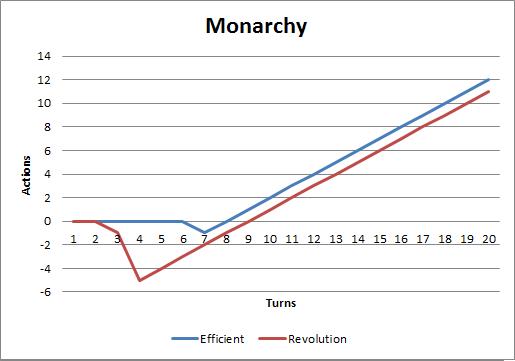
Monarchy is the only government which can provide a benefit through Revolution.  This is mainly due to the decreased cost to generate Science at the beginning of the game.  The benefit of Revolution will generate a single additional action at the end of the game.  The chart for revolution of Monarchy is shown below:
For Monarchy, and Theocracy, there is a 'ramp up' time needed to gather the science.  From the chart above, the earliest a Revolution can take place is on turn 4, the turn after taking the government card.  The Revolution costs all the Civil Actions for the government, so in this case it is the equivalent of costing 4 actions.  The result is the Revolution costs one action.

For the remaining Government technologies, we make the assumption the science is immediately available, regardless of whether Revolution or normal change.  In all of these cases the Revolution action costs greatly exceed their action return.
Maximum Generated Actions
The following chart tracks the absolute maximum number of actions in an ideal game.

The recipe for this is as follows:
  • Turn 1 (Actions:2): Take Hammurabi, Pyramids
  • Turn 2 (Actions:1): Play Hammurabi, Increase Population,  Build a Mine
  • Turn 3: Build Philosophy
  • Turn 4 (Actions:2): Take Code of Laws, Build Stage 1 of Pyramids
  • Turn 5 (Actions:3): Play Code of Laws, Build Stage 2 and Stage 3 of Pyramids
  • Turn 10 (Actions:5): Take Republic, Play Republic, Take Kremlin, Build 2 Stages of Kremlin
  • Turn 11 (Actions:1): Build Stage 3 of Kremlin
  • Turn 16 (Actions:2): Take Civil Service, Play Civil Service
Since the Build Mine and Increase Population actions are 'normal' actions, they do not count against the actions need to bring the items into play.

The maximum number of actions returned through this method is increased by 68.  Thus, the theoretical maximum actions a player may have is 148.
Reality Check and Conclusions
Many things affect achieving the maximum number of actions available:

  • Cards not appearing at perfect times,
  • Event cards removing resources/actions,
  • Taking cards higher in the Card row,
  • Other Players Military Actions.
With these factors in play, a player can reasonably expect to achieve between 30% and 60% of these additional actions.  This leaves a player between 100 and 120 actions.  I would like to say these estimates are based off some real data, but in this case it is based on an intelligent guess.  Roughly half of these actions will be available in Age I, about 10% in Age II, and the remainder will arrive in Age III. 

If we make the fair decision a player will have an average number of actions, this comes to 114 actions.  Based on the above charts, it is sensible the actions will be divided as follows:
  • Age A (Turn 1): 4/turn (preset by rules/not changeable)
  • Age I (Turns 2-4): 4/turn
  • Age I/II (Turns 5-11):  5/turn
  • Age II/III/IV (Turns 12-20):  7/turn
This increase in actions explains the acceleration factor seen in the game.  Each of Ages I through III has 55 cards.  Age II runs faster than Age I by a single turn, but Age III runs through the same number of cards in just over half the number of rounds as Age I.  During Age III players accumulate more actions and spend these actions on more cards on the card row.  The more cards players collect, the faster the Age ends.
How to Use This Information
Players who understand how much can be accomplished in a game lets them better prioritize their choices.  It lets a player realize the impact of their decisions in card selection and order of playing cards.  specifically, the following points can be made:
  • Once a government is chosen, it is never efficient to switch governments a second time,
    • Especially through revolution.
  • Republic generates the most total civil actions of all cards,
  • Kremlin and Hammurabi are roughly equivalent in Return on investment if the Kremlin comes up early and is immediately build 
    • Hammurabi has a better guaranteed return, whereas Kremlin may arrive too late to be effective.
  • Players have roughly 114 civil actions during a game, meaning players should plan how to spend these actions at the start of the game.
There are other cards which were not reviewed that may impact actions available.  Isaac Newton permits the learning of technologies without expending actions, and Robespierre allows revolutions using Military Actions instead of civil actions.

I want to continue the discussion on Actions, but will switch to Culture Generation.  What issues have you experienced with Actions and might want advice on, or what comments do you have about the information above?

Tuesday, December 20, 2011

Through The Ages-Part V-Actions: Civic Cards

The forum for this blog is located at: http://gamesstrategyandtactics.freeforums.org/strategy-analysis-f6.html.

Civil Technologies
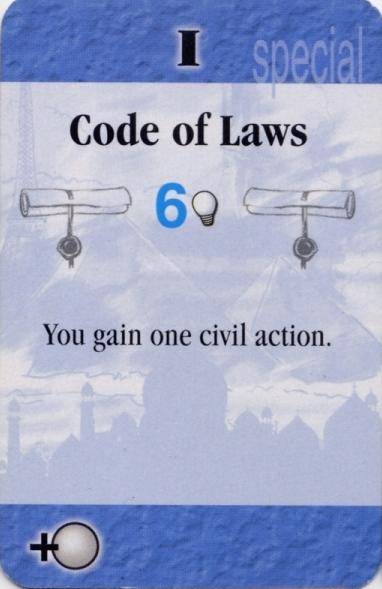
Three civil technology cards exist to increase actions: Code of Law, Justice System, and Civil Service.
Code of Law

TIPAction CostRecipe
Expedient35Turn 1:Take RevIdea-A
           Take IdlBusSite-A
Turn 2:Play IBS-A Philosophy
           Take RevIdea-I 
 Turn 3:Play RevIdea-A
           Play RevIdea-I
           Play Code of Law 
Efficient52Turn 3: Build Philosophy
Turn 5:Take Code of Law
           Play Code of Law
Expected44
Turn 3: Build Philosophy
            Take RevIdea-I
Turn 4:Play RevIdea-I
          Take Code of Law
          Play Code of Law
Max Benefit = 14
Analysis
Code of Law provides one of the best ways to gain actions.  At half the Science cost of Monarchy, Code of Laws is relatively cheap on the Science.

In all cases it is required to build a philosophy.  For the Expedient this is built on Turn 2 using Ideal Business Site.  For the other processes, the Philosophy must be built on Turn 3 without using a card.


Justice System

TIPAction CostRecipe
Expedient94Turn 9:Take Justice System
           Play Justice System
Efficient102Turn 10:Take Justice System
           Play Justice System
Expected112
Turn 10:Take Justice System
           Play Justice System
Max Benefit = 9
Analysis
Justice System occurs about halfway through the game, at best.  It may provide a maximum benefit of 9 actions if played around turn 10, but most likely the benefit will be less.  Despite costing only one more Science than Code of Laws, it is inferior in generating Action points.


Civil Service

TIPAction CostRecipe
Expedient94Turn 9:Take Civil Service
           Play Civil Service
Efficient102Turn 10:Take Civil Service
            Play Civil Service
Expected112
Turn 10:Take Civil Service
            Play Civil Service
Max Benefit = 8
Analysis
Civil Service is the last Civic Special Technology card which provides actions.  Despite being a late game technology, Civil Service provides an almost immediate return on its investment.  This means no matter when the Civil Service comes out, it is guaranteed to generate its Action cost in return, at least as long as no other Civic cards are already in play.  Even so, if the game is guaranteed to last one more turn, Civil Service is will generate an action profit.


Switching Civic Cards
Analysis
If a player switches civic cards there is the risk of losing actions needlessly.  The chart to the left displays the results of a change to the civic actions.  From the chart, going form Justice System to Civil Service  or from Code of Laws to Justice System results in an overall loss when compared to just the Code of Laws.

The best gain is to switch from Code of Laws to Civil Service, granting a total yield of 17 actions.


Conclusions
Basically, if concerned with Actions, all three Civic cards provide a decent return.  Their largest drawback is the science cost.  The earlier Age Civics provide greater overall return than their later Age Civics.  However, switching from either Age I to the Age III Civil Service will provide a net increase in almost all regards.

In the case of switching from Age I to Age II will always result in a net loss of actions.  The best return begins with the Code of Law and switches to the Civil Service.  At most, civic technologies will provide an additional 17 actions to a player's game.